Skip to content
PTEN
Cognitive behavioural therapy

CBT: cognitive behavioural therapy, what it is and how it works

CBT works on the relationship between what you think, what you feel and what you do, with clear goals and a focus on the present. Understand how it works and book your first session on WhatsApp.

  • Focus on the present and on goals
  • In person in Lisbon or online
  • Sessions of about 50 minutes
  • Psychotherapists with a professional licence
With Susana Firmino and Tereza Villanueva
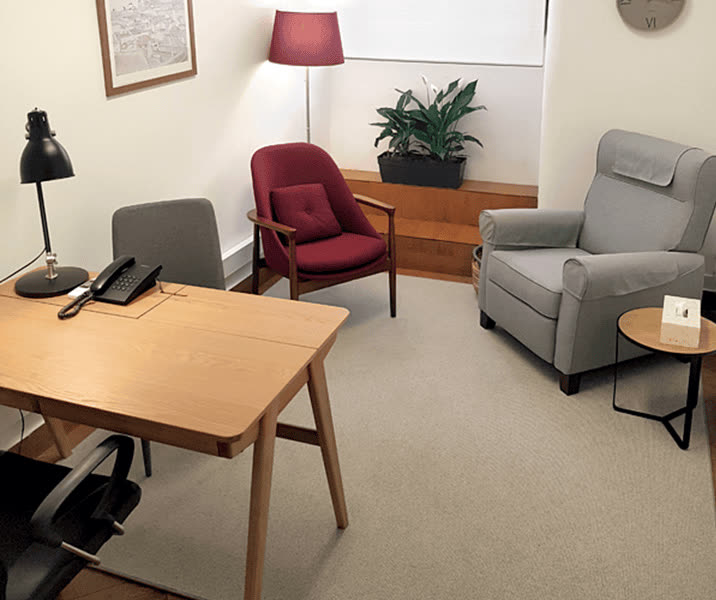
One of Psicovias's consulting rooms in Lisbon, with a desk, an armchair and natural light
First session via WhatsAppIn person in Lisbon or online
  • Presentworks on today's problems, not only the past
  • Goal-basedgoals set with you from the start
  • Exercisespractice between sessions to consolidate change
  • 1960screated by Aaron Beck and widely studied since

What CBT is

CBT (cognitive behavioural therapy) starts from a simple idea: it is not events themselves that affect us, but the way we interpret them. That interpretation influences what we feel and what we do next.

The work is practical. The therapist helps you notice those thoughts, test them and try out other responses. It has points in common with EMDR therapy and hypnotherapy, and is often combined with them.

Psicovias's CBT therapists

All Psicovias psychologists hold a professional licence. You can choose who works with you or let us suggest the most suitable person for you.

Susana Firmino

Susana Firmino

CBT Psychotherapist and Coach

OPP licence no. 12159

Clinical psychologist since 2007. In her psychotherapeutic practice she favours cognitive behavioural therapy and coaching. She has worked with children and young people since 2010.

View profile →
Tereza Villanueva

Tereza Villanueva

EMDR and CBT Psychotherapist

CRP 01/27842 (Brazil)

Online sessions, individual and couples.

View profile →

How CBT works, step by step

Each session has a focus. In general, the path goes through four stages.

  1. Noticing automatic thoughts

    These are quick thoughts, sometimes just an image, that appear before the emotion. You learn to catch them, for example by recording them through the day.

  2. Questioning the beliefs behind them

    Many come from childhood or from significant experiences. We look at what sustains them and build more balanced alternatives.

  3. Trying out new behaviours

    For example, gradually facing the situations you avoid, with relaxation and problem-solving techniques.

  4. Practising between sessions

    Small exercises to do at home help you keep what you have learned after therapy has ended.

What CBT is used for

It is used for many difficulties. Some examples:

One thought, two readings

Your boss calls you into their office. The situation is the same; what changes is the thought.

Automatic thought

  • “I've done something wrong”
  • Anxiety, sweaty hands, racing heart
  • You arrive at the meeting expecting the worst

More balanced thought

  • “It could be for many reasons; I'll listen”
  • Calmer, and attentive to what is said
  • You respond clearly

What CBT asks of you, and its limits

It is not a magic solution. It works best with your participation and a good relationship with the therapist.

What it asks of you

  • Active participation in the sessions
  • Records and exercises between sessions
  • Regularity, even when you feel better

When it may not be enough

  • Some cases call for a complementary approach, such as EMDR or hypnotherapy
  • Some people prefer to explore the past in more depth
  • We always assess this at the first session

Frequently asked questions about CBT

What is CBT, in a few words?

It is a psychotherapy that combines cognitive therapy (what we think) with behavioural therapy (what we do). It focuses on goals and on the present, and teaches strategies for dealing with everyday problems.

Who created CBT?

Cognitive therapy was born in the 1960s, with the American psychiatrist Aaron Beck, who began by studying the negative and distorted thoughts of people with depression. Since then it has broadened to other difficulties.

What are automatic or dysfunctional thoughts?

They are quick, involuntary thoughts, sometimes just an image, that arise in a situation and that we do not usually question. When they are exaggerated or unrealistic, they lead to emotions and behaviours that harm us. See also how to deal with ruminating thoughts.

Where do core beliefs come from?

They are lasting convictions about ourselves, others and the world. They form throughout life, beginning with upbringing and childhood. They can be positive or negative (“I'm a failure”, “I'm not worthy of love”), and it is the negative ones that therapy works on most.

What is the difference between a thought and an emotion?

“I only ever mess things up” is a thought. The shame, sadness and tightness in the chest that go with it are the emotion and the body's reaction. In CBT you learn to tell them apart, because only then can you work on the thought.

Does CBT work?

It is one of the most studied psychotherapies. A 2012 review identified 269 meta-analyses of CBT and concluded that its evidence base is very strong, with the strongest support in anxiety disorders, anger control and stress. As with any therapy, results vary from person to person and depend on each person's involvement.

How many sessions are needed?

It depends on the problem and how you respond. Some people notice improvement in a few sessions and others need a longer course. We talk about this with you at the first session.

What techniques are used?

The most common are thought records, cognitive restructuring, gradual exposure to feared situations, social skills training and relaxation techniques.

Why is there homework?

Because change happens mostly outside the consulting room. Exercises, such as observing the thoughts that arise and the emotions they cause, help consolidate what is worked on in the sessions.

CBT or EMDR: which to choose?

CBT works mainly on today's thoughts and behaviours. EMDR is widely used when there are difficult memories or trauma. Some people do both. At the first session we see which makes more sense for you.

Can I do CBT online?

Yes, by video call, from anywhere in Portugal or abroad. In-person sessions are also available in Lisbon. See who can work with you and what it costs.

Psychologist, cognitive therapist or CBT psychotherapist: is it the same thing?

For someone seeking help, yes: they are professionals who practise CBT. What matters is that they have specific training and a professional licence. See how to choose a CBT therapist.

Can I have therapy even without a diagnosis?

Yes. Therapy is also for self-knowledge, stress management and building confidence. If you are not sure you need it, read when to see a therapist.


Sources and recommended reading

Reference bodies and studies, if you would like to read more. They do not replace an assessment by a professional.

How to book your first CBT session

  1. Get in touch

    Send us a WhatsApp message or an email. We will agree a day and time.

  2. First session

    In person in Lisbon or online. We listen to what worries you and see whether CBT makes sense for you.

  3. Plan and continuity

    We set goals and a regular rhythm, for example weekly.

Book your first CBT session

Write to us on WhatsApp and we will agree a day and time, in person in Lisbon or online.